sábado, 16 de abril de 2016

Biochemistry

Biochemistry

My future career goals are to get accepted in a Graduate school for study MD and PhD in Biochemistry. But no matter what are your future goals is important search information and have knowledge about the field that you want to study. Now, let’s talk about briefly how this idea of study biochemistry evolved  and what is this field.

Briefly, this idea evolved in this way:

I have to say that my parents suffer fibromyalgia disease. This disease does not have cure and it can be hereditary, etc... I took a class of chemistry and was my lab teacher the person who inspired me to study biochemistry to can help my parents. I like biology and chemistry so why not? Then I look for information and I concluded definitely to study it.

Biochemists have to understand both the living world and the chemical world. Even if you don’t want to become a biochemist, you'll still have to understand atoms and molecules as a biologist. The key thing to remember is that biochemistry is the chemistry of the living world. Plants, animals, and single-celled organisms all use the same basic chemical compounds to live their lives. Biochemistry is not about the cells or the organisms. It's about the smallest parts of those organisms, the molecules. It's also about the cycles that create those biological compounds.
In other words, biochemistry is the branch of science that explores the chemical processes within and related to living organisms. It is a laboratory based science that brings together biology and chemistry. By using chemical knowledge and techniques, biochemists can understand and solve biological problems. Biochemistry focuses on processes happening at a molecular level. It focuses on what’s happening inside our cells, studying components like proteins, lipids and organelles. It also looks at how cells communicate with each other, for example during growth or fighting illness. Biochemists need to understand how the structure of a molecule relates to its function, allowing them to predict how molecules will interact.

     Biochemistry covers a range of scientific disciplines, including genetics, microbiology, forensics, plant science and medicine. Because of its breadth, biochemistry is very important and advances in this field of science over the past 100 years have been staggering. It’s a very exciting time to be part of this fascinating area of study.

What do biochemists do?
·         Provide new ideas and experiments to understand how life works
·         Support our understanding of health and disease
·         Contribute innovative information to the technology revolution
·         Work alongside chemists, physicists, healthcare professionals, policy makers, engineers and many more professionals

To conclude, my purpose to show you my experience is because sometimes we know that we like more than one field and we think that we cannot fusion them or study them all. That is totally false!! Now I exhort you to look for information of all the fields that you like and see how you can mix them because that is totally possible.
Do not forget see the video and if you want to know more about biochemistry go to my references. (Copy and paste the link)


References:
1.      http://www.biochemistry.org/?TabId=456
2.      http://www.chem4kids.com/files/bio_intro.html

3.      https://www.youtube.com/watch?v=tpBAmzQ_pUE
4. https://www.youtube.com/watch?v=RiRStrWg5k8&ebc=ANyPxKo5uMRSXIkuOTFdFTSDirfgBmQn1qtGhGiq1aKuYnxFTpk_r6WeRF0QLEP80YGad8z2dV9UyhCiQV1gv1u005Ocg6B7WQ

viernes, 8 de abril de 2016

INSPIRATION IN SIMPLE THINGS


INSPIRATION IN SIMPLE THINGS

     We all can be important persons in science or other fields. We all can get the inspiration of something and create innovate things that are important for the humanity. I am going to present a resume of a new of C&NE that is an example of inspiration in simple things.

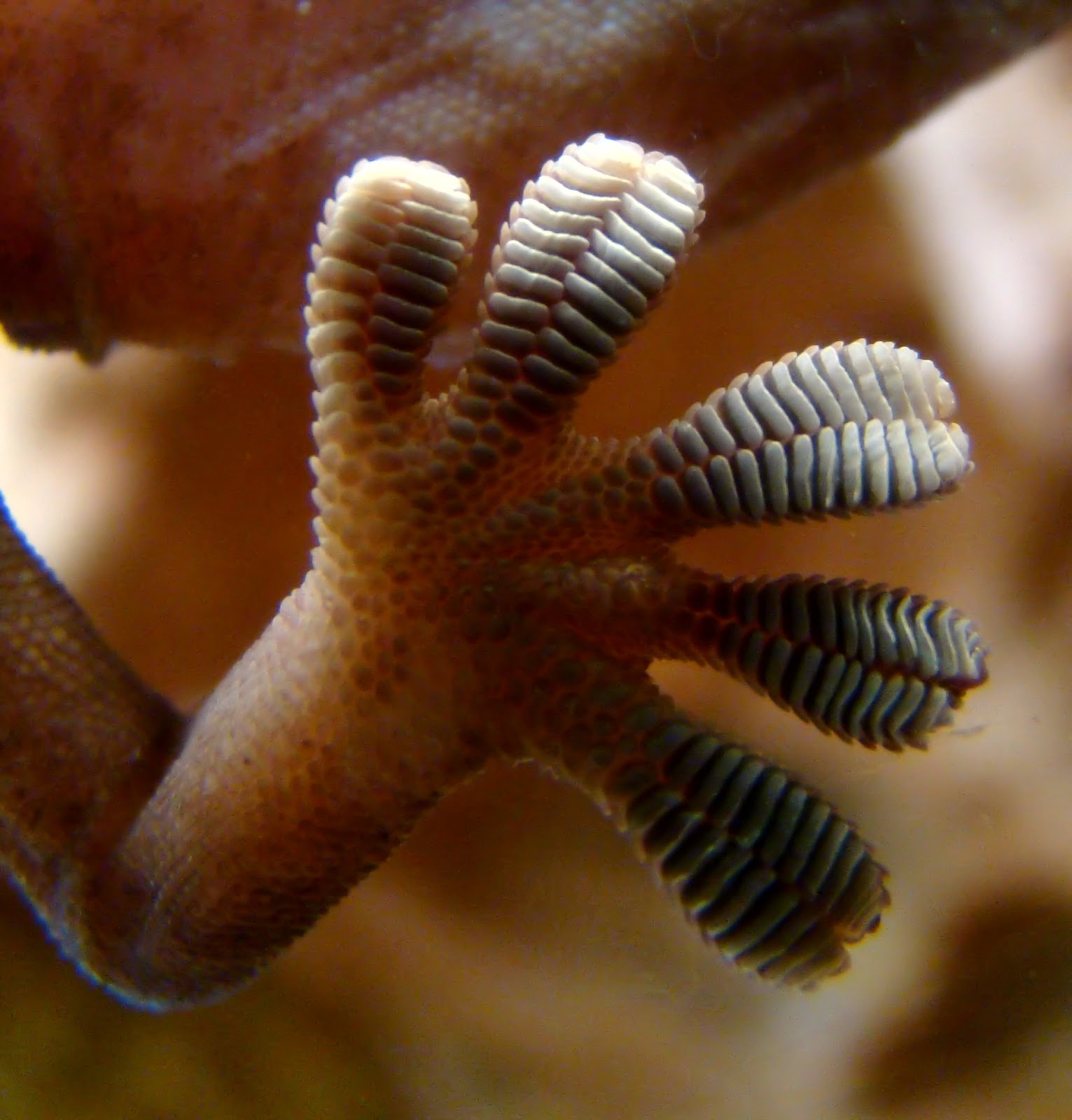
     Gecko feet are covered with microscopic, spatula-shaped hairlike features that allow them to run up walls and across ceilings. The millions of microhairs are called setae. Each seta is between 30 and 130 micrometers long and branches out to end in several hundred flattened tips called spatulae. This unique structure allows the gecko’s toes to have unusually close contact with the surfaces it climbs. The close contact allows intermolecular forces which are significant at short distances, to hold the gecko to the wall.

     As we know, molecules can attract each other at moderate distances and repel each other at close range. The attractive forces are collectively called "van der Waals forces". Van der Waals forces are much weaker than chemical bonds, and random thermal motion around room temperature can usually overcome or disrupt them.

    Researchers have previously mimicked these features by creating materials with flat-topped microscopic pillars that cling to surfaces via van der Waals interactions. A new take on adhesives inspired by sticky gecko feet has led to soft, stretchy silicone patches that conduct electricity and cling fast to skin, even when underwater. The material could be used as comfortable, low-cost, reusable electrocardiography (ECG) electrodes for heart monitoring. Today’s disposable silver-based ECG electrodes have rigid metal parts and use glues that can irritate the skin. They can come off when wet or from too much movement, limiting a user’s ability to shower or exercise during longer periods of monitoring.

     The new material could also be “crucially important in next-generation skinlike technologies for wearable electronics,” says John A. Rogers, a materials science professor at the University of Illinois, Urbana-Champaign, who was not involved in the work. Rogers and others are developing conformable tattoolike sensors to monitor fitness and various health conditions. The new material could make such devices more durable while doubling as an electrode.

     Finally, Ronald S. Fearing, an electrical engineering and computer science professor at the University of California, Berkeley, says that such low-cost, nontoxic, skin-compatible electrodes may “find applications in interfaces for prosthetic devices, or perhaps even for monitoring muscle performance while exercising.” And unlike present-day ECG electrodes, he says, “long-term wear could be an option.” The KAIST team hopes to create other gecko adhesive variations by adding materials other than carbon. “For example, fillers with functionalities such as thermal conductivity, magnetism, and luminosity are excellent candidates for realizing different types of multifunctional, self-adhesive platforms,” Jeon says.


If you want to read more about this new, go to references. Do not forget see the images below.
Thank you!
Stephanie


A scanning electron micrograph shows 15-µm-tall pillars made of a polydimethylsiloxane composite containing carbon nanotubes and graphene powder. The soft, stretchy material conducts electricity and sticks to various surfaces, including skin.


References
http://cen.acs.org/articles/94/web/2016/04/Gecko-inspired-adhesives-stretchy-conductive.html
Images from:

https://www.google.com.pr/search?q=gecko&espv=2&biw=1517&bih=692&source=lnms&tbm=isch&sa=X&ved=0ahUKEwjb56CVvf_LAhUEx4MKHUFYC80Q_AUIBigB&dpr=0.9#imgrc=fxeMwgrruW1BUM%3A

https://www.google.com.pr/search?q=gecko&espv=2&biw=1517&bih=692&source=lnms&tbm=isch&sa=X&ved=0ahUKEwjb56CVvf_LAhUEx4MKHUFYC80Q_AUIBigB&dpr=0.9#tbm=isch&q=gecko+foot+microscope&imgrc=Fmq2wKguMkc7wM%3A


domingo, 3 de abril de 2016

Myth: There are only three states of matter.


Myth: There are only three states of matter.


     I remember growing up and learning all about solids, liquids and gases. When I get accepted in college I learned that exist other states or phases of matter. The books and the information on internet almost always says that “there are only 3 states of matter, solid liquid and gas”. But is important to know that that ones are “the three most well-known types of matter” or “the three types of matter we are most scientifically familiar with”

     The most common types of changes in the phases of matter consists of changing its physical characteristics not chemical characteristics .The best way to think of a phase changing the physical nature of a substance is with the common example of water, ice, and steam. They can occupy nearly the same region of space, and be in completely different phases. Consider a glass of ice water. The ice is in a solid phase, the water is in the liquid phase, and the humid air consisting of the evaporating gas is in another phase. While chemically they are the same, what makes them in different phases is that they are physically distinct from each other.

     Most types of matter can transition into these physically different phases based on the amount of heat present. For instance, everyone knows that if you add heat to a solid it will usually transition into a liquid at least to most part of the matter. If you continue adding heat, the material will transition into a gas.

     At least there are 13 different states of the matter. That number approximately quadruples the number of the basic sates that we all know. Is very important to know it because we can contribute to our scientific education and correct our professor even email a lot of companies that produce the books that we have to buy. And at the same time we stop the myth of the three states that is continuing forward to next generations from child to professional adults.

Some examples of other states of the matter are:

1. Plasma: If you continue to add heat you will turn that gas into plasma. Plasma is an ionized gas, it means that the atoms that compose it have broken away from some of its electrons. Thus, the plasma is similar to gas but composed of anions and cations (ions with negative and positive charge respectively), separated from each other and in free state, so it is an excellent conductor. A clear example is the sun.

2. When you continue cooling a substance to almost absolute zero, you can get what is known as a Bose-Einstein condensate. Due to the need to keep substances at extremely low temperatures, these condensates have not been proven to occur naturally in our universe, although theoretically they could exist.

3. Other, even less known, phases of matter involve the substance’s magnetic characteristics. The most recent example was published in the journal “Nature” in December of 2012. Researchers at MIT were able to grow a crystal (a solid) that had magnetic characteristics of a liquid. While most magnetic solids have defined positive and negative areas within the substance, known as magnetic moments, this crystal’s specific magnetic moments fluctuated constantly without outside influence. Not only were they able to discover this new type of matter, but simultaneously they discovered something of a new type of magnetism!

4. Super-solid: This material is a solid in the sense that all of the atoms of helium (4) that compose it are frozen in a rigid crystalline film, similar to as are the atoms and molecules in a solid normal as ice. The difference is that, in this case, "frozen" does not mean "stationary". So, As the film helium-4 is so cold (just a tenth of a degree above absolute zero), begin to prevail the laws of quantum uncertainty. Indeed, helium atoms begin to behave as if they were solid and fluid simultaneously. In fact, in the right circumstances, a fraction of helium atoms begin to move through the film as a substance known as "super-fluid," a fluid that moves without any friction.

As technology advances, scientists use ever more sophisticated techniques that allow us to know more about the world we live.

See the videos below and share your opinion with me. If you want to read more about this topic see the references.

Have a Great week!
-Stephanie


References

http://www.todayifoundout.com/index.php/2013/08/there-are-more-than-three-states-of-matter/

http://www.taringa.net/post/ciencia-educacion/12403040/Los-estados-de-la-Materia-Ni-tres-ni-cuatro-trece.html

https://www.youtube.com/watch?v=n-17xqfF4FU

https://www.youtube.com/watch?v=1RpLOKqTcSk

domingo, 27 de marzo de 2016

Coligative References


Colligative Properties


As always I say: “Chemistry surprises you with the simplest things that you used to do in life”.


   Now, I am going to ask you: Have you ever seen people adding salt to ice in an ice cream maker? Have you ever traveled to countries where the snow is falling and in the next day people sprinkle salt on icy roads?
     The reason that people do this is not an alien behavior; they do because salt lowers the temperature at which water freezes. So, the question is how chemistry explains this? The temperature enough to make water harden into ice is 32 degrees Fahrenheit or 0 degrees Celsius. But when you sprinkle salt on ice, salt which is a compound called sodium chloride, interrupts the freezing process of the water. Some of the ice will melt because the salt pulls some water away from its crystal form (ice) and also mixes with the thin layer of water on top of the ice. This creates more saltwater, which will melt more ice. The dissolved salt will also prevent the melted ice (now water) from refreezing. Molecularly, salt slows the action of water molecules trying to join together into crystals to form ice or snow. Now, the temperature to form ice again is about -10°C.
     For example: on a winter road, the salt allows the ice to melt when the ambient temperature is below freezing. In other words, for the mixture of salt and ice or salt and water, it has to be colder than 0° C or 32° F to freeze. The depression of freezing point of water by salt is an example of the colligative properties of solutions.

The colligative properties are: freezing point depression, boiling point elevation, osmotic pressure and vapor pressure lowering. To understand how these properties work I am going to explain briefly the concept of solution.
     In general, a solution is a homogeneous mixture composed of a solute and solvent. The solute is the minority component which in this case is the salt and the solvent is the majority component which in this case is the water. The colligative properties depend on the number of particles (solute) that were dissolved in solution (that contain solvent). Basically, the more salt (solute) is added to the same amount of water (solvent), the lower its freezing point will be.


Let’s use chemistry in our favor to can go out in winter without the snow covering us at all.


I want to know others chemistry tricks that you use to combat the snow?
Let me know which are yours and remember see the video and photo below. Also, if you want to read more about colligative properties go to the references.


Thanks,

-Stephanie


References

1) https://www.highlightskids.com/science-questions/how-does-salt-melt-ice-and-snow

2) Tro, N. J.; “Chemistry: A Molecular Approach”, 3rd ed., Pearson Prentice Hall: New Jersey, 2014.

jueves, 17 de marzo de 2016

Chemiluminescence

Chemiluminescence

Yes, I am sure that you read the title twice because you cannot pronounce it in the first try. Now, you are smiling because what I said before is true. Do not worry I had to pronounce it almost 25 times to explain to my colleagues what that is?  Let’s talk about luminescence in Chemistry or best known as Chemiluminescence.

     Everyone at once has seen glowsticks in a night club, fireflies or beautiful jellyfishes glistening, but from where comes the illumination of those things or species? The answer is simple, is because the Chemiluminescence. This is the production of light from a chemical reaction. Two chemicals react to form an intermediate in excited state (high energy), which is de-energized releasing some of its energy as photons of light.

     For example: Luminescent reactions of fireflies use ATP (adenosine triphosphate) as a source of energy. The structure of molecules that produce the light in fireflies varies from species to species, but they are generically called luciferins. When fireflies glow, the luciferin is oxidized to produce an excited complex, which falls back to the ground state, releasing a photon of light. That light is what we see at night into the woods.

     Fluorescent jellyfish are probably the epitome of chemiluminescence and bioluminescence sophistication. They have a protein capable of receive high-energy light (typically in the range of UV) called GFP (Green Fluorescence Protein) that emits fluorescence in the range of green light (Although biotechnological modifications have gotten proteins that emit virtually the entire visible spectrum). Jellyfish are not nearly the only bioluminescence’s marine life, it is believed that more than 90% of animal species average and abyssal ocean portion emit some kind of bioluminescence. Also, there have been a series of experiments investigating aequorin, a protein found in certain jellyfishes, which produces blue light in the presence of calcium and therefore can be used in molecular biology to measure calcium levels in cells.   


     Other way to see chemiluminescence… I think that everyone in a particular moment has seen Action or Police movies which have scenes where a forensic scientist investigates if in a zone there is blood present. And he or she does it using an apparatus with light that show in seconds the blood stains. Basically, in real life forensic scientists use reactions of luminol to detect blood at the crime scene. A mixture of luminol in a dilute solution of hydrogen peroxide is applied in the area where they suspect that is the blood. The iron in the hemoglobin of blood accelerates the reaction and when the room is dark and if blood is present, a blue glow, lasting 30 seconds is observed. Forensic investigators can record the glow by using photographic film, which can be used as evidence in court of blood in the scene.


Some scientists have proposed other ideas for utilizing chemiluminescence in the future; from detect important ions in biological processes to have fluorescent fishes as decoration. What other alternatives you think is useful for us, based in this natural phenomenon and the concept of chemiluminescence?
Let me know.


Have a great week!!

-Stephanie

References:
https://tallcute.wordpress.com/2008/01/15/colores-vivos-de-la-naturaleza-a-la-biotecnologia/
http://www.scienceinschool.org/node/2355
http://www.bbc.com/mundo/noticias/2013/01/130116_bioluminiscencia_naturaleza_produce_luz
Images from:
http://www.slideshare.net/kendonsmith/electron-configurations-notes
http://bioloblogeo.blogspot.com/2015/03/como-se-iluminan-las-luciernagas.html
http://dciencia.es/c-s-i-dciencia-el-luminol/
http://slickzine.com/nature/stunning-jelly-fish-photography/

sábado, 12 de marzo de 2016

Magic Chemistries

Magic Chemistries

As I said before my purpose with this blog is not only share information that you cannot understand or you do not like it or bores you. I want to catch your attention with chemistry; science is not boring at all. Everyone in a moment dreams to have super powers or abilities to do magic. Now, I have to tell you: that dream IS POSSIBLE WITH CHEMISTRY!!

Chemists use reactions to produce different compounds. The majority of magic chemistries are related to mix the correct things to have the most surprising products. There is a many types of chemical reactions that chemists do but the most used to magic chemistries are: oxidation-reduction, combustion, synthesis, decomposition, substitution or single replacement or metathesis. Doing these reactions correctly we can produce: invisible inks, substances that change mysteriously of color, water that muddies blowing air, an egg fry without oil and heat, lemonade that turns into wine, white sugar becomes in black coal. It looks like magic, but it is the product of chemistry and its reactions. And that is why I call it magic chemistries.

You can use chemistry in your favor to surprise other persons during a magic show or to have fun with your family or friends or use it in science projects to catch the attention of your public.

Below are the scientific or chemical concepts behind two chemical tricks that you can do carefully and with the consent of your parents:

   1)    Set money on fire and watch it burn out without damaging the bill.
A combustion reaction occurs between alcohol and oxygen, producing heat and light (energy) and carbon dioxide and water.
C2H5OH + 4 O2 -> 2 CO2 + 3 H2O + energy
When the bill is soaked an alcohol-water solution, the alcohol has a high vapor pressure and is mainly on the outside of the material (a bill is more like fabric than paper, which is nice, if you've ever accidentally washed one). When the bill is lit, the alcohol is what actually burns. The temperature at which the alcohol burns is not high enough to evaporate the water, which has a high specific heat, so the bill remains wet and isn't able to catch fire on its own. After the alcohol has burned, the flame goes out, leaving a slightly damp dollar bill.
Materials: dollar bill, tongs, a lighter, salt, solution of 50% alcohol and 50% water (you can mix 95% alcohol with water in a 1:1 ratio, if desired)
Procedure:
   1.     Prepare the alcohol and water solution. You can mix 50 ml of water with 50 ml of 95-100% alcohol.
   2.     Add a pinch salt or other colorant to the alcohol/water solution, to help produce a visible flame.
   3.     Soak a dollar bill in the alcohol/water solution so that it is thoroughly wet.
   4.     Use tongs to pick up the bill. Allow any excess liquid to drain. Move the damp bill away from the alcohol-water solution.
   5.     Light the bill on fire and allow it to burn until the flame goes out.

   2)    Smoking fingers.
Phosphorus is a chemical element that can take several forms, called allotropes. The type of phosphorus in the striker of match boxes is red phosphorus. When you burn the striker, the phosphorus is vaporized and condenses into a solid onto the cool metal surface. This is white phosphorus. The element has not changed identify just the structural arrangement of the atoms. Rubbing your fingers together produces enough heat from friction to vaporize the phosphorus into what appears to be smoke.
White phosphorus readily reacts with oxygen in air to form a flammable compound. Because of this, one of the earliest uses of the purified element was to make matches. The early phosphorus-based matches were dangerous, containing enough phosphorus to poison a person. Modern matches are called "safety" matches because they don't use highly toxic chemicals. The smoking fingers trick used to be a popular school science demonstration. It is not performed much anymore because of concerns about the risk from the phosphorus, but if you do the trick infrequently, the dose of phosphorus is small. You can lessen the exposure by wearing thin, disposable gloves and taking care not to breathe the vapor.

Materials: matchbox of safety matches, cold water faucet or chilled pan, scissors, lighter
Procedure:
    1.     Cut out the striker portion of a matchbox from a box of safety matches. Trim off any paper around the striker.
    2.     Fold the striker in half, striker-sides facing each other.
    3.     Set the folded striker on top of the running cold water faucet or a refrigerated metal pan.
    4.     Use a lighter to set fire to the striker. Ignite both ends. Then run the lighter along the length of the folded striker. It won't burn to ash, which is fine.
    5.     Discard the burned striker.
6.     You will see a brown residue that has been deposited along the top of the faucet or metal pan. Run your fingertip along the residue to pick it up.

Never is too late to make happy other persons, let’s make happy them with chemistry. I invite you to read more of magic chemistries in the references and see the videos below.

See you later chemist-wizards,
-Stephanie


References:
http://chemistry.about.com/od/demonstrationsexperiments/ss/burnmoney.htm
http://chemistry.about.com/od/chemistryhowtoguide/ht/smokingfingers.htm


sábado, 5 de marzo de 2016

What is Chemistry?

What is chemistry?

     In my previous entry I explain briefly that all have chemistry. Now the question is what is chemistry?

     Basically, Chemistry is the study of the matter, its properties and how and why substances combine or separate to form other substances. As I said before many people think of chemists as being white-coated scientists mixing strange liquids in a laboratory, but the truth is we are all chemists. Now, I am going to present a list of two things that I realize we all do without being conscious that we are changing physical or chemical properties of the matter.

  1.   From mix milk with coffee to sweeten the coffee we are doing chemistry. To mix milk with coffee we are mixing two liquids with different chemical and physical properties, they interact and produce a good taste to us.

How we know that this is change in the properties of liquids? Because if we taste only milk or only coffee we can realize that the tastes are different than when they are mixed. Also we can see that milk is white and the coffee is dark brown, so they have different colors which mean that they have different physical properties. Then when we mix it and we have prepared our coffee with milk, this is called a physical change of the matter.

Now, if we sweeten the coffee, we can see that the sugar dissolves into the mix. We again change the physical properties of the sugar because it passes from solid to liquid. Why  it is a physical change? Because if we changed the state of the matter of the sugar. We are not changing the chemical properties because we have the same sugar, if that would be a chemical change the sugar become to another thing. For example:

   2.  When we are into the woods. When we are into the wood and we turn on a wood fire we are doing a chemical change to the matter. Why? Because a log burning in a fire with the presence of heat and oxygen is transformed into carbon dioxide, water vapor, and ash. Now, we do not have the log because it becomes another thing: ash. And if we want our log again we have to find another one because we can’t reverse the ash to the log.

Usually, we can identify a physical change with key words as dissolves, state change, color change, odor change, and change in volume…etcetera. And a chemical change with words like: combustion, energy, oxidation, corrosion, etcetera.

     Summarizing, every day we practice chemistry doing physical and chemical changes to the matter. 

Now, I invite you to see the photos and the video below. If you want read more about chemistry click on the links in the references or copy and paste the link in search bar.


Thank you very much and have a nice week,
-Stephanie


References: video from: https://www.youtube.com/watch?v=gCbqjs-pqJo
http://www.livescience.com/45986-what-is-chemistry.html